
I Thought I Was Lazy: Why Successful Adults Can Have ADHD for Decades Without Knowing It
Medically reviewed by Joni McMurchy, MSN, PMHNP-BC, Inner Compass Mind Health.
You got through school. You built a career. Maybe a successful one.
You pay your bills, take care of a family, show up for other people, solve complicated problems at work, and somehow manage to keep most of the plates spinning.
So ADHD probably isn't something you've ever seriously considered. Besides, you aren't the person bouncing out of a chair who can't pay attention.
But there may be another side of your life that people don't see.
You have an email you've needed to answer for nine days. It would take three minutes. Every morning you tell yourself, Today I'm going to answer that. You don't.
There's a bill sitting on the counter you've walked past twelve times. You've opened your computer to accomplish one specific task and, 45 minutes later, realized you've somehow done six other things. You put something somewhere so you absolutely will not lose it. Then you lose it.
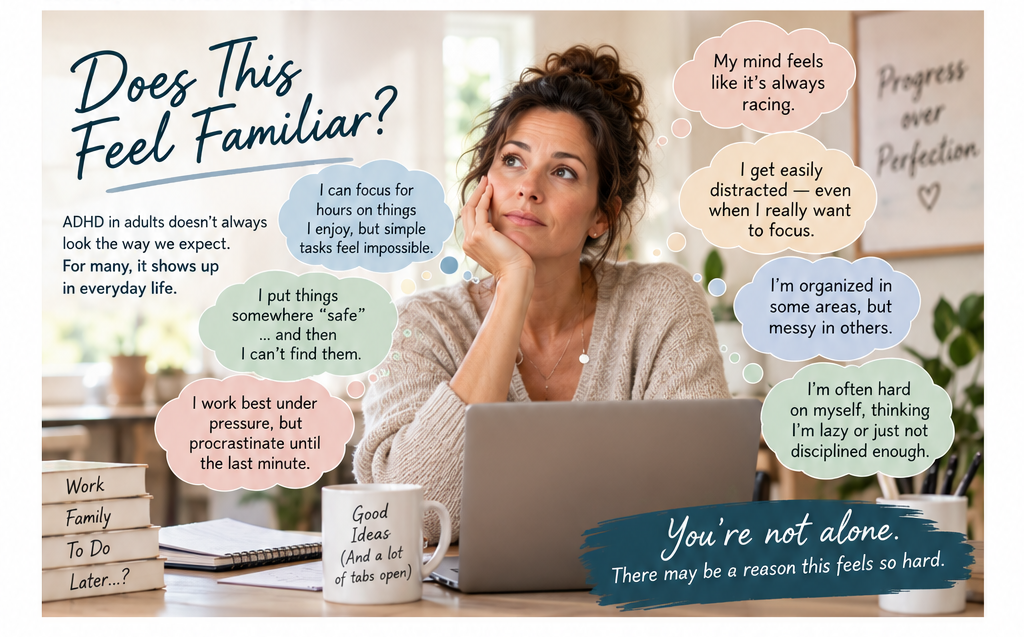
And there are the bigger things. You can accomplish an astonishing amount of work when a deadline is tomorrow yet struggle for days to begin the same project when the deadline is three weeks away. You can become completely absorbed in something that interests you, sometimes for hours, but have enormous difficulty concentrating on something mundane.
Why can I do incredibly difficult things, but struggle with things that should be easy?
Many high-functioning adults with ADHD go undiagnosed for decades because they build coping systems — lists, alarms, perfectionism — that mask the underlying difficulty. If you consistently struggle with tasks that should be easy despite real success elsewhere, ADHD may be part of the explanation.
Somewhere along the way, you may have settled on an explanation: I'm lazy. I'm disorganized. I'm a procrastinator. I'm terrible with time. I just need more discipline.
But for some adults, there may be another explanation worth exploring: ADHD.
Adult ADHD Doesn't Always Look the Way We Imagine It
Many of us still carry a childhood picture of ADHD: a child who can't sit still, a student staring out the window, someone constantly getting in trouble at school. That picture is incomplete.
ADHD is a neurodevelopmental disorder. It begins during development, but it doesn't necessarily disappear when someone reaches adulthood. What often changes is how it looks.
By adulthood, you've had years to compensate. You make lists. Set multiple alarms. Put everything in your calendar. Arrive early because you know what happens when you try to arrive five minutes early. You create systems to prevent yourself from forgetting things.
Sometimes those systems work extremely well. That's one reason ADHD can remain hidden in intelligent, accomplished adults. Success doesn't tell us how easily someone achieved something. It only tells us that they achieved it.
“But I Can Concentrate for Hours”
Some adults dismiss ADHD because they can concentrate - sometimes so intensely that they forget to eat lunch. The problem isn't necessarily an absence of attention. For some people with ADHD, the difficulty is regulating and directing attention.
“I can't pay attention” is different from “I have difficulty controlling what gets my attention.”
An interesting problem, urgent deadline, new idea or personally engaging task may hold attention extremely well. A repetitive administrative task with no immediate consequence can be another story. That creates one of the most confusing experiences associated with adult ADHD: inconsistency.
The Deadline Problem
The presentation is Friday morning. Monday: I should start. Tuesday: I really need to start. Wednesday: Tomorrow. Definitely. Thursday at 8 p.m., suddenly the brain that couldn't get started is completely engaged.
Distractions disappear. Hours pass unnoticed. At 1:47 a.m., the presentation is finished - and it's good. The next morning, everyone sees the excellent presentation. They don't see the process required to produce it.
This can continue for years because, strangely enough, it works. Until it doesn't. Responsibilities increase, careers become more demanding, families need more attention and sleep becomes more precious.
Eventually, adrenaline becomes an expensive productivity system.
The Successful Person Nobody Suspects
She became exceptionally organized because she had to. He became a perfectionist because mistakes terrified him. She checks everything three times. He stays at work longer than everyone else. She writes everything down because she doesn't trust herself to remember it.
These people may not look like they're struggling. They may look extraordinarily capable - and they are capable. But capability and difficulty can exist at the same time.
The better question may be: How much effort does it take you to maintain that success?
When Coping Starts to Look Like Personality
Live with something long enough and you may stop seeing it as a coping mechanism. It becomes who you think you are: I'm terrible with paperwork. I always lose things. I need pressure to perform. I'm chronically late. I'm a perfectionist. I'm lazy.
That last word deserves attention. Laziness suggests you don't care enough to do something. Executive-function difficulties can feel very different. You care. You know exactly what needs to be done. You may even be anxious because you aren't doing it. Yet beginning the task feels inexplicably difficult.
That experience doesn't mean someone has ADHD. But it is a good reason to stop treating every difficulty with motivation as a character flaw.
ADHD Can Have an Emotional Side, Too
A criticism can stay with you all afternoon. A frustrating interaction can produce an intense reaction. You may become irritated quickly and wonder twenty minutes later why you were so upset, or replay a conversation repeatedly.
Research in recent years has increasingly examined emotional dysregulation in adults with ADHD. A 2023 systematic review found associations among difficulties regulating emotion, ADHD symptom severity, executive functioning and other mental-health difficulties. That doesn't mean every intense emotion is caused by ADHD, but it does mean ADHD can involve considerably more than losing your keys.
“How Did Nobody Notice?”
For someone diagnosed at 35, 45 or 55, this can be one of the hardest questions. Sometimes the answer is simple: people weren't looking for what you were experiencing.
This can be particularly relevant for women. Recent research has examined how ADHD in women may be overlooked or misidentified, especially when symptoms don't fit the familiar stereotype of the disruptive, hyperactive child.
Instead, the difficulties may have accumulated under other descriptions: anxious, disorganized, forgetful, overwhelmed, perfectionistic or underachieving. Or perhaps the sentence that followed you for years: “You're so smart. If you'd just apply yourself...”
For some adults, receiving a diagnosis later in life brings relief - finally, there is an explanation - but relief can coexist with grief: What if I'd known when I was 20? Would college or my career have been different? Why did I spend so many years believing I was lazy?
Being diagnosed with ADHD in adulthood doesn't necessarily mean ADHD suddenly appeared in adulthood. ADHD is considered a developmental condition, so clinicians generally look for evidence that symptoms were present earlier in life, even if nobody recognized them as ADHD at the time.
Sometimes Life Used to Provide the Structure
School provided schedules, deadlines and external accountability. Your first job may have had a manager setting priorities. Then you were promoted and suddenly you had to create the structure. Or you started a business, began working remotely, had children or started caring for aging parents.
The brain may not have suddenly changed. The demands did.
Strategies that worked at one stage of life may no longer be enough for the next. That's often when someone begins asking: Why am I struggling now?
Recognizing Yourself Here Doesn't Mean You Have ADHD
Almost everyone procrastinates, gets distracted and forgets things. Difficulties with concentration or executive functioning can also have other explanations, including anxiety, depression, inadequate sleep, substance use, medications and some medical conditions.
That's why an online quiz - or a blog post like this one - can't diagnose ADHD. The bigger questions are how persistent the difficulties are, how much they interfere with your life, whether they occur in more than one setting, and whether the pattern extends back into childhood. For more on ADHD in adults, CHADD's National Resource Center (chadd.org) is a good starting point
So What Does an Adult ADHD Evaluation Actually Look Like?
A thorough adult ADHD evaluation generally involves much more than checking a few boxes on a questionnaire. A clinician may ask about attention, organization, impulsivity and time management, along with work, relationships, education, sleep, mental health, substance use and childhood history.
Standardized ADHD questionnaires may be used. Sometimes information from a spouse, parent or another person who knows you well can help. Old school records or report cards may occasionally provide clues about symptoms earlier in life.
A computerized assessment may also be used as one part of the evaluation. Depending on the tool, it may measure aspects of attention, response time, impulsive responding or consistency while you complete a task. These results can give the clinician another piece of information, but a computerized test by itself does not diagnose ADHD.
The clinician should also consider other possible explanations, such as anxiety, depression, a sleep disorder, medication or substance use, or another medical or mental-health condition. Sometimes ADHD is the answer. Sometimes it isn't. Sometimes ADHD exists alongside another condition.
The goal isn't to prove you have ADHD. The goal is to understand why you're struggling.
And If It Is ADHD?
There are treatments. Depending on the individual, treatment may involve medication, psychotherapy or behavioral approaches, education about ADHD, practical strategies for organization and time management, environmental changes, or a combination of these.
Treatment isn't about turning someone into a different person. It's about reducing the difficulties that interfere with the life that person is trying to live.
Instead of asking, “Why can't I just be more disciplined?” you can begin asking, “What kind of structure helps me do this?” Instead of, “Why do I keep failing at this?” you can ask, “What is getting in the way?”
Maybe You Aren't Lazy
Maybe you've spent years compensating for something you didn't understand. Maybe you've become remarkably successful while privately wondering why ordinary life sometimes requires so much effort. Or maybe ADHD isn't the explanation at all. That's important to leave open.
But if you've spent years thinking, I know what I'm capable of. Why can't I consistently access it? it may be worth becoming curious about that question rather than judging yourself for asking it.
“Maybe there is a reason this has been so difficult.”
And that realization can be the beginning of a much more useful conversation. If this sounds familiar, an adult ADHD evaluation can help you understand what's really going on. Inner Compass Mind Health offers whole-person psychiatric evaluations for adults in Florida — schedule a free 15-minute consultation today. We offer in telehealth evaluations with evening and weekends scheduling
Frequently Asked Questions About Adult ADHD
Can you develop ADHD as an adult?
Not exactly — ADHD is a developmental condition that begins earlier in life, but it's often not recognized until adulthood, when new demands (a promotion, kids, less external structure) outpace the coping strategies that worked before.
What does an adult ADHD evaluation involve?
A thorough evaluation typically covers attention, organization, impulsivity, and time management, along with work, relationship, sleep, and childhood history — often combined with standardized questionnaires and sometimes a computerized attention test.
Is it still ADHD if I did well in school or at work?
Yes. Many adults with ADHD compensate through intelligence, perfectionism, or high effort. Success shows that someone achieved something — it doesn't show how much effort it took to get there.
Can anxiety or depression look like ADHD?
Yes — anxiety, depression, poor sleep, and other conditions can all produce similar attention and focus difficulties, which is why a proper evaluation considers alternative explanations rather than relying on a checklist alone.
Is an online quiz enough to know if I have ADHD?
No. Online quizzes and articles like this one can help you decide whether it's worth exploring further, but only a full clinical evaluation can determine whether ADHD explains what you're experiencing.
Joni McMurchy, MSN, PMHNP-BC
Inner Compass Mind Health
Whole-person psychiatric care for adults throughout Florida
Medical Note
This article is for education and general information and is not a diagnosis or substitute for individualized medical advice. ADHD symptoms can overlap with other medical, psychiatric and sleep-related conditions. If problems with attention, impulsivity, organization, time management or emotional regulation are significantly affecting your work, relationships or daily life, consider discussing them with a healthcare professional experienced in evaluating ADHD in adults.
Recent Research & Further Reading
• Ginapp CM, et al. (2022). The lived experiences of adults with attention-deficit/hyperactivity disorder: A rapid review of qualitative evidence. https://pubmed.ncbi.nlm.nih.gov/36032220/
• Surman CBH & Walsh DM (2022). Do Treatments for Adult ADHD Improve Emotional Behavior? A Systematic Review and Analysis. https://pubmed.ncbi.nlm.nih.gov/35822610/
• Soler-Gutiérrez AM, et al. (2023). Evidence of emotion dysregulation as a core symptom of adult ADHD: A systematic review. https://pubmed.ncbi.nlm.nih.gov/36608036/
• Attoe DE & Climie EA (2023). Miss. Diagnosis: A Systematic Review of ADHD in Adult Women. https://pubmed.ncbi.nlm.nih.gov/36995125/
• American Psychiatric Association (2022). Diagnostic and Statistical Manual of Mental Disorders, Fifth Edition, Text Revision (DSM-5-TR). https://www.psychiatry.org/psychiatrists/practice/dsm
